Wednesday, August 31, 2005
Jalianwala Bagh Memorial in Amritsar
Share

Jalianwala Bagh :
Located just 5 minutes walk from the Golden Temple, enclosed by old buildings on all sides, this is one monument that lies peacefully remembering those who had laid down their lives at the hands of colonialist impresser. There is no arched entrance here. Just a 3 feet galli between two buildings leads you into the memorial. A marble plaque on the wall says that Gen. Dyer bought his guns through this galli. Once you are into open space, a pyramid shaped stone stands at the point from where firing on the crowd was carried out. Some of the surrounding buildings still bears the marks of bullets that missed the crowd and got embedded in the walls. The Martyr’s Well is an enclosed monument. There is a martyr’s gallery inside the park. The place bears a peaceful atmosphere despite a large number of tourists.
People in Amritsar observed a hartal on 6th April, 1919 to protest against the Rowlatt Act (passed in Mar, 1919). Following this protest British arrested Dr. Saifuddin Kitchlu and Dr. Satyapal, two noted leaders of the city. This led to a lot of resentment and violent unrest in the city. Sir Michael O’Dwyer, who was the Governor of Punjab, had declared martial law. Following this Brig. Gen. Reginald Edward Harry Dyer from Jallandhar cantonment took over control of the city. Around 2000 people had gathered on the Jalianwala Bagh compound in the afternoon of 13th April, 1919 to held a meeting. It was the Baisakhi day. Gen. Dyer bought his force to the ground and started indiscriminate firing on the crowd. The firing started at 10 minutes to six and lasted for about 7 minutes. This left 337 men, 41 boys and one 7 week baby dead. 120 bodies were recovered from the well located in the area.
Following a resolution by INC, a trust was formed in 1920 to build a memorial in the place of massacre. The piece of land originally belonged to one Bhai Hamit Singh Jallawala. The trust bought this land in 1923 for a price of Rs.5.65 lakh, a huge amount then. The memorial was inaugurated on 13th April, 1961 by the then President of India, Dr.. Rajendra Prasad in presence of leaders like Jawaharlal Nehru.
On Mar 13, 1940, Udham Singh shot dead Sir Michael O’Dwyer, the DC of Amritsar during the massacre, at the Caxton Hall in London. Udham Singh was present at Jallinwala Bagh on that fateful day. According to him Sir Dwyer was actually responsible for the killings. Udham Singh was later hanged in London. Among those remembered in the martyr’s gallery at the park is Madan Lal Dhingra who embraced martyrdom by shooting dead William Curzon Wylie and Kiwis Lal Kaka on July 9, 1909 at a meeting of the Indian National Association at the Jehangir House in London. He was later hanged in London.
posted by Rupankar Mahanta at 10:52 PM
|
0 comments
![]()
Please DO NOT post comment with url. If you have an url, then you should request for a link exchange.
Tuesday, August 23, 2005
The Crashed Car
Share


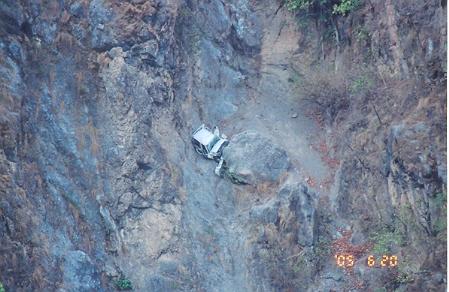
This car was seen dangling between rocks about 10 km upwards from Byashi on the Rishikesh - Badrinath route. We were told that nobody survided. The car is in no condition to be pulled out. A grim reminder of what may happen as a result of rush driving in the hills. I had to zoom this at 300mm for this view. See the other one below.
Labels: Badrinath, Photography, Travel
posted by Rupankar Mahanta at 9:54 PM
|
0 comments
![]()
Please DO NOT post comment with url. If you have an url, then you should request for a link exchange.
Monday, August 22, 2005
Going to Amritsar
Share
It was boring siting through 3 extended weekends. Finally a plan was thought of -- initially for Almora or Nainital. But we found that only one way journey from Dehradun to Kathgodam is a comfortable one as the overnight train that runs between these two stations runs only twice a week. That means one way of around 390 km had to be covered by road or take the brave decision to halt 2/3 hors at midnight at Moradabad, a UP town. None of us was in favour of any of these two option and so the idea of nainital had to be dropped. Further it is still raining here in Uttaranchal regularly which often results in landslides. My wife suddenly suggested to go to Amritsar as there is a daily train from Dehradun to Amritsar. Finally we all had agreed for Amritsar. I thought that only Golden temple is there at Amritsar. But after exploring a little bit, I found that we can see the Wagah Border (just 30km away) and the Jaliwanbagh memorial as well. So guys we are going there next weekend. Hope to write next week.
posted by Rupankar Mahanta at 10:33 PM
|
0 comments
![]()
Please DO NOT post comment with url. If you have an url, then you should request for a link exchange.
Mysore : the city of palaces
Share

The Mysore Palace:
Among all the buildings in Mysore, the Palace stands out. This is the star attraction of Mysore. Designed by the English Architect, Henry Irwin, the Mysore Palace dominates the skyline of Mysore. A three storied structure in the Indo-Saracenic style built between 1897-1912, the palace is an exquisite piece of architecture. It has been converted into a museum. It has quite a good number of display. The huge paintings and other displays gives you a feel of the opulence of royal life. The place is crowded as everyone going to Mysore can not miss it.
A board manages the palace. It is money spinner for the descendants of the royal family. You are to pay many times inside the complex. Entry fee to the palace is Rs.20/-. Cameras are not allowed and you have to deposit cameras at the gate and also pay Rs.10/- as custody charge. Then you need to pay for keeping your shoes. There also exist within the complex another old palace that seemed like a wooden structure. You need to pay another Rs.20/- per head for entering that. If you are in a large group, you will avoid it as I did. I bet you will not find another such site where you will have to face the greed of the people managing it. Foreign tourists are also seen taking elephant rides around the complex. My recommendation is that visit the main palace as you do not get such opportunity to be in a royal palace which is in such good shape and skip the old one. Most of such palaces in good condition in India had been converted into five star hotels. But just keep in mind that the people who owned this palace were collaborator of the British and helped the British in their war against Tipu just to be in power. Inside the palace you can feel the British patronage. While most of Tipu’s valuables were plundered by British army and took them to Britain, valuables of the Wodeyar kings are still in display here.
The palace looks magnificent when lighted at night. The palace is illuminated on Sundays, Public Holidays as well as during the Dassera Celebrations when 97,000 electric bulbs are used to illuminate it.
Lalitha Mahal :
We had purchased a pack of postcards to know about places worth seeing. Lalitha Mahal is also an important building of the city landscape. It has been converted into a 5 star hotel. The white coloured building looked magnificent from distance. So we went there. The guard at the gate told that only customers are allowed in. However he let us in when we promised to pay him 10 bucks. We took a detour of the complex and came out. We did not pay the guard the 10 rupees and he shouted at us.
Chamundi Hills :
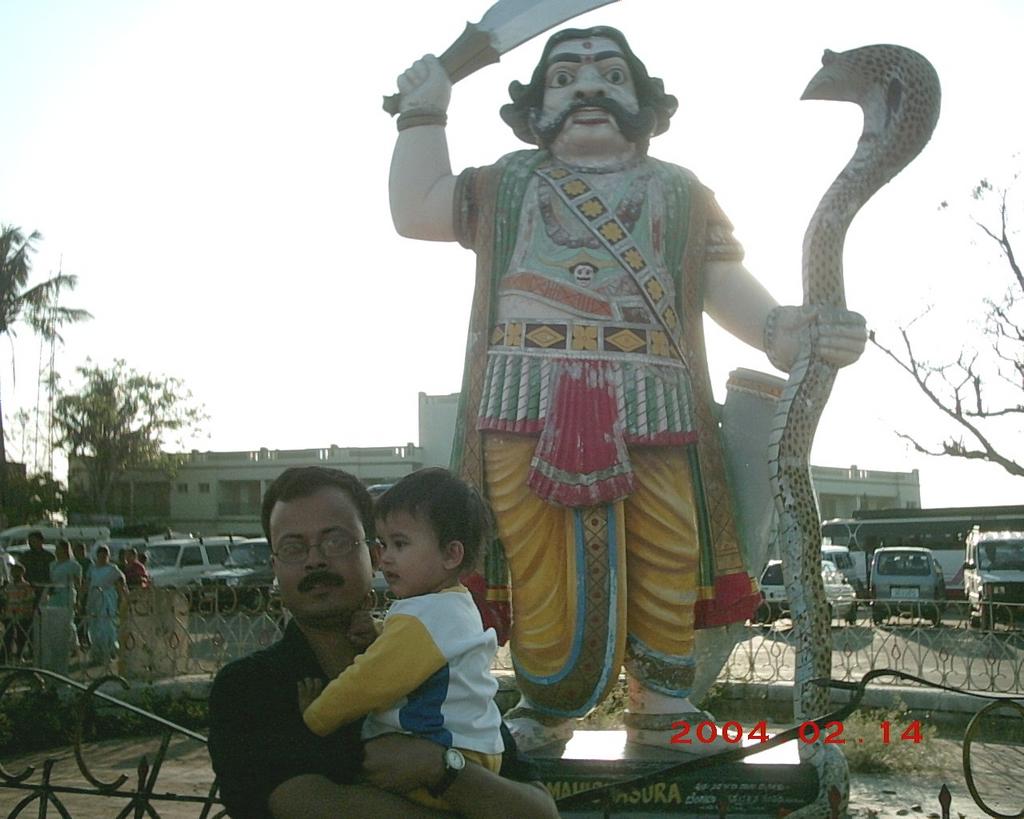
Thereafter we proceeded to the famous Chamundi Hills around 12 km from the city. At the top there is an eleventh century Chamundi temple. But the main attraction there is the statue of Mahisasura located in the parking area. Photographs taken with the statue of Mahisasura in the backdrop uniquely identifies that place as Mysore. Look at the photo on the right. I bet you have seen a lot of them. The white coloured dome of the temple looked beautiful. I did not went inside the temple. There are dharamsalas here for if someone wants to stay. Wodeyar kings had constructed a stairway of 1000 steps to the temple from the foothills in the town.
Then we came down to watch the Nandi statue which is located exactly halfway down the hills. Towering at a massive 5 meters, carved from a single rock in 1659 this sculpture is really a must-see.
The St. Philomena Church:
We came back to the town to have a look at the ST. Philomena Church. This is a beautiful gothic structure with twin spires, 175ft. in height. Built in 1933, it is said to have been modeled on the gothic Cathedral at Cologne. The church building was stunning. The altar bears the statue of St. Philomena,a third century saint from Greece. This one should not be missed.
Brindavan Gardens :
I had heard a lot about this place. I am sure you also have heard about those colourfull musical fountains of Brindavan Garden of Mysore. The park opens for public at 7 pm. We sped through the 17 km distance from the city to be there on time. The place was crowded right from the parking area. We had to walk down half a kilometer to buy tickets @ Rs.10/- per head and paid another Rs.10/- per camera. Once inside, a tedious journey wading through surging crowd started. It was like in a mela where you have no option but to follow the sea of crowd at their pace. To my estimate there should not be less than 15 / 20 thousands people there. We had to walk down at least 2 km along the Krishnarajasagar dam to get the sight of the first fountain. But where are the lights and more importantly where are the waters! Some tourist had to ask the officials present there. They said that most of the fountains had to be shut down due to lack of water. Cauvery can hardly feed the Bangalore city and Tamil Nadu is always crying for more water. It cannot feed these fountains anymore for your aesthetic pleasure. So why is the garden for without fountains and water. It was such a big disappointment. We were told that some of the fountains actually flow even now when it rains. We managed to reach the reservoir. On the other side of the reservoir, we could see lights from some fountains that may be running. Flashes were clicking there. But after the disappointment of coming this far of nearly 2.5 km, we were in no mood to walk down another one km. So did many other tourists. I must say, that this was the biggest disappointment I ever had visiting such a famous tourist destination. My advice is: do not go there. But you may still not resist the feeling of skipping Brindavan Garden. Imagine how much money the garden is making daily as gate fees! In lakhs. You will not only waste your money but few hours going there.
posted by Rupankar Mahanta at 10:15 PM
|
1 comments
![]()
Please DO NOT post comment with url. If you have an url, then you should request for a link exchange.
Thursday, August 18, 2005
Srirangapatna : The capital of Tipu
Share

We took a left turn off the Banglore-Mysore highway to visit the Dariya Daulat Bagh, the summer palace of Tipu. It has been converted into a museum and you need to pay gate fees to enter the complex. Photography is allowed in the garden but prohibited inside the palace. The palace is a beautiful piece of sculpture made of teak wood in Indo-Saracenic style. It was built in 1784. The walls are completely covered in beautiful paintings many of which depicts Tipu’s war against the British rulers. Look at the photo which I took somehow by avoiding the guards. There are few historical artifacts in display there. However most of the valuables have been plundered by the firangis after the death of Tipu and they are getting sold off at Sotebey’s. 64 of Tipu’s artifacts were sold for £1.23 million in a Sept. 2003 auction. Vijay Mallya spent £500000 of his fortune to bring back many of the artefacts back home. To know more about this auction read on this news link Auction of Tipu’s artifacts .
Thereafter we crossed the main road to visit the fort which is located on the right hand side of the Bangalore-Mysore highway. People lives inside the fort area and so it hardly looked like a protected monument. Most part of the walls of the fort were destroyed in the fourth Mysore war in 1799. All the historical monuments like the Sri Ranganatha Swamy temple, the Jumma Masjid are scattered around the ruins of the fort. However the place where Tipu’s bullet ridden body was found is now protected with fencing. I had seen a report in the net showing children playing cricket using the tombstone as stumps indicating how neglected it was. Fortunately this is now fenced.
It takes about an hour to visit these memorabilia in Srirangpatna. It was a nice feeling to be able to visit this place that has so much importance in our fight for freedom. We then continued our journey to Mysore.
Labels: Srirangapatna, Tipu Sultan, Travel
posted by Rupankar Mahanta at 10:58 PM
|
5 comments
![]()
Please DO NOT post comment with url. If you have an url, then you should request for a link exchange.
Friday, August 05, 2005
Horror of Zombies
Share
So the internet has tackled the horror of Zombies successfully. But we may actually see a real Zombie in future. Scientists at the Safar Centre for Resuscitation Research, Pittsburgh, USA has successfully created eerie zombie dogs, reanimating the canines after several hours of clinical death in attempts to develop suspended animation for humans. subject's veins are drained of blood and filled with an ice-cold salt solution. The animals are considered scientifically dead, as they stop breathing and have no heartbeat or brain activity. But three hours later, their blood is replaced and the zombie dogs are brought back to life with an electric shock. Plans to test the technique on humans should be realised within a year, according to the Safar Centre. Don’t believe. Read on this news link Zombie Dogs Recreated
Labels: Internet
posted by Rupankar Mahanta at 11:04 PM
|
0 comments
![]()
Please DO NOT post comment with url. If you have an url, then you should request for a link exchange.
Thursday, August 04, 2005
Story of the Bicycle
Share

In the year 1816, extreme weather conditions were experienced across the world due to the Mount Tambora volcano eruption. This massive eruption in Indonesia in April, 1815 killed nearly a lakh people and threw so much ash into the atmosphere that the average global temperature dropped by 3 degrees. There was no summer in Europe in 1816. This led to poor harvest and prices of horse oats had increased so much that Drais got into thinking of replacing the horsepower with manpower. So he developed the first bicycle, the velocipede. This machine was in fact a four-wheeler driven by a treadmill or cranks attached to the rear axle. They were designed for two; a servant pedaled at the rear while the owner steered and supervised the operation from the front. He demonstrated this piece of machine in his hometown Baden on 12 June, 1817. This however did not catch the fancy of masses and so he diverted his attentions to other inventions.
However, prices of oats kept rising and Drais once again had to get into the idea of a machine to replace horses. This time he developed a two wheeler bicycle that indeed used the key principle of modern bicycle: balance on two wheels. This machine was called the Draisine. The Draisine pioneered other features of today's bicycle. It had brass bushings - elementary bearings - in the wheels to cut friction, and its frame of well-seasoned ash weighed only 20 kilograms, making it as light as a modern bike. This also had a brake though not that effective. He won royal support for this machine and was granted a kind of patent in Baden. However, some people in Britain and the US pirated his idea and got copies developed by them patented by different names. In Britain it was called the Hobby-horse. However, these copies did not have any brakes and so resulted in many accidents. Further, balancing act on two wheels was a new concept which people found difficult to adopt. This disillusioned people and a campaign against velocipedes was started. A change of guard in his home state Baden also saw a campaign by Drais’s enemies starting a campaign to malign him by trying to prove him as mad. He lost the royal favor and eventually died penniless in 1851. His idea of replacing the horsepower by manpower went a long way.
Want to know more about bicycles. Read on this link Bicycle
Labels: Internet, Useful Info
posted by Rupankar Mahanta at 10:26 PM
|
0 comments
![]()
Please DO NOT post comment with url. If you have an url, then you should request for a link exchange.
Tuesday, August 02, 2005
Kaziranga National Park : the pride of Assam
Share

There are three entry points for going into Kaziranga – Kohora, Bagori and Agratoli each of this being a separate ranges. The most popular range is Kohora followed by Bagori. Like most tourists, I also have been to Kohora only and hence my article is limited to Kohara only. My directions will be from Jorhat side rather than Guwahati side. Kohora is about 22 km from Bokakhat, the nearest town and looks like an ordinary alighting point on the highway. A small no. of shops and a welcome arch ensures that you do not miss it. The road on the left (or right if you are coming from Guwahati) with the big arch leads you to the point where most of the renowned hotels and rest houses are located. Though many new roadside hotels and resorts have come up in the area, this is the best place to stay as the forest office from where you are to obtain passes for entering the park is located here. The hotels here are Banani, Banashree and Aranya. Besides this, there is the Soil Conservation IB where I had stayed. Room rates starts from around 550 onwards. The famous Wild Grass Resort is however about 7 km from here and is located amidst a local village. It is built to give you an ethnic feel. Most foreign tourists stay at the Wild Grass. There is no road sign for Wild Grass and the kachha road that leads to it off the highway is at exactly 5 km from the Kohora point towards Bokakhat. You need to ask someone after traveling for 5 km for the way to Wild Grass. But if you are not a luxury class tourist, then prefer to stay in any of the places I have mentioned above. Their phone nos. are given at the end to confirm availability. Except Hotel Aranya, others accept telephonic bookings. Soon after you arrive rush to the forest office to register your name for elephant safari next morning. Which trip you get to go in depends on your serial no. in their register. The best trip is the second one at 6:30 am and so do not forget to register yourself early. During Mar- April, however the best trip will be the first trip at 5:30 am. If you stay in any far off hotel located along the highway, they may be having some agent to book on your behalf. Get it confirmed beforehand with the hotel. Each trip carries about 50 to 60 tourists depending on the availability of elephants.
I had arrived there around noon and so I had to take the afternoon jeep safari. You can choose to take it in the morning half as well. Afternoon timings are fixed from 3 pm to 5 pm. It was November and so by 5 pm it becomes quite dark in Assam. You have to hire the jeep yourself from market or through the hotel staff. They charge around 650 bucks per trip. Prefer to have a gypsy rather than a jeep as gypsy travels almost noiselessly. Afternoon trip gives you an opportunity to travel alone. If you are traveling in cavalcade, which is normal situation in morning, be sure to be in the front otherwise whirlwind of dust emanating from the kachha track inside the jungle will take some of the fun away. The forest deptt. charges are quite exorbitant. I had compared this with the rates in Periyar NP in Kerala in one of my earlier article. The charge are : Rs.200/- for vehicle entry fee, Rs.60/- per head entry fee, Rs.50/- for still camera, Rs.50/- as guard charges and Rs.500/- if you have a handycam. It is real loot-maar. They will however give you a forest guard who has an old .303 gun to scare animals away, especially elephants, if they attack you.
Day 1: Jeep safari
We entered the jungle through Mihimukh at around 3 pm. It was quite cool in Feb and so animals were around. A kutcha road leads you into the jungle. I am told that this road gets wiped out every year in flood and has to be rebuilt before the park opens. You can easily spot various species of deers and wild boars in swamps alongside the road. The drivers will invariably show you a tree which bears nail marks supposedly of tiger. Soon you will start spotting rhinos and buffalos either grazing or lying lazily in a mud pool. The driver was friendly and we were taken 4/5 km into the jungle to the Diphalu river where we could see some tortoise. They were dangling from trees lying on riverbed. Even the smallest of crackle will scare them to vanish within seconds into water. The air was carrying fragrance of jungle flower. It was a nice feeling to be so deep inside a dense forest. On the way we saw destruction caused by an elephant herd which had crossed that area the day before. If you get an elephant herd on the way, that is the end of safari for you as those beasts will not make for you. The road is very narrow; you cannot turn and run if chased by elephants. On our return, two barking deers, which are rarely seen, slowly walked onto the road hardly 100 meters away from us. They did not hear us coming. That is why I recommended having a gypsy rather than a jeep. Unfortunately my SLR struck in the snap I took with both the deers. However, the second snap with only one of the deers came good. As the sun was setting we were taken to the Diphalu lake for watching the sun set. Few tourist vehicles gathered there for enjoying the sunset. By the time we had returned it was complete dark.
The day was not over yet. At 7 pm the forest office opens for issuing passes for next morning’s elephant safari. You had to be there personally to pay and collect passes. Even if you had registered yourself earlier, if you are not present when your name is called you will miss the chance to choose your trip. Although I had registered at around 3 pm, I got the chance to be in the second trip as many tourists were not present when their names were called. So collect your entry passes before going for dinner. The charges were Rs.120/- per head plus Rs.50/- for still camera.
Day2: Elephant safari
We had to face a cab operator strike and so had to drive down to Mihimukh, the elephant riding point located about 3 km from the highway. We left the vehicle there at the gate and walked down to the tower built for getting onto the elephant. In fact you can easily drive there. The cab operators typically charge Rs.200/- for ferrying you from hotel to Mihimukh and back. The area was still engulfed in thick fog. I felt lucky that I did not have to go in the 5:30 am trip. We waited on the machaan for the elephants to come back from the first trip. It was a wonderful sight to see the cavalcade of majestic animals emerging through the foggy landscape in the distance. There were 17 elephants in the troupe of which 15 are used for ferrying tourists and 2 were under training. Though most of the elephants belongs to the forest deptt., few of them are privately owned. Carrying capacity of each elephant varies depending on its size. We got into a 3 seater pachyderm. Slowly one by one all the elephants vanished into the fog. So did we. The elephants had great difficulty in maneuvering swamps and crossing a small river on the way. I was sitting at the back and felt at times like felling off from the elephant. Soon we were taken to a herd of wild water buffalo which were yet to make its move for the day. After traveling for some time we get to see a rhino. We did not get to see anything else in the one-hour trip. But traveling through the tall elephant grasses, which at times towers above the elephants, in the jungle through the fog was something special. The beauty of the elephant safari is that you can see whatever you get to see from very close. I have read that elephant safari in other national parks is more fun than animal watching. But here you get both the fun and animals. I had really enjoyed the ride. Honestly it was my first elephant ride and I am happy that it was a memorable one for reasons other than that. We came back to Mihimukh in about an hour. Before alighting we ensured to have photograph on the elephant. This was the time my SLR started giving problems. Fortunately our photos on elephant taken by another tourist came good.
That also brings an end to my trip. This is a typical Kaziranga trip we use to enjoy in Assam. If you have planned to spend two days, then you can have the jeep safari at Bagori on the second afternoon. The distance between Kohora and Bagori is about 10 km. It was November when I visited. The park opens for tourists in October and remains open till mid April. But the best time to visit is end March or early April around Bihu (or just before the rain starts). Till about December, your views of the landscape will be blocked by the tall elephant grass jungles that are everywhere. They dries up by January and the forest deptt. set them on fire to clear areas. Once the pre-monsoon rain start setting in, freshly sprouted grass brings out large number of animals into the open and you can enjoy this magnificent view in March - April. However, this window is small as park is closed once the rain gets regular by mid of April. Before ending here are the phone numbers of hotels ----
Hotel Aranya : 03776-262429, Hotel Bonani : 03776-262423,
Soil Conservation IB : 03776-262409
Wild Grass Resort : 03776-262085/262437/ 0361-2546827 (Guwahati office)
For further information, you can try the following link :
Kaziranga National Park
posted by Rupankar Mahanta at 11:30 PM
|
2 comments
![]()