Friday, April 05, 2024

Holi Tiger

तस्माद्व्याघ्रो वनं रक्षेद्वयं व्याघ्रं  पालयेत् 


Majestic: a king in his kingdom

John Doe were looking eagerly in the direction where the forest rangers were trying to locate a collared tiger sleeping inside bushes. Suddenly, one gypsy driver shouted- पीछे देखो….बाघ पीछे से आ रहा है (Look back..tiger is coming from the other side). It was another tiger who came looking for her mating partner lying in the bushes. Holy cow! We just had our first tiger sighting at the most unlikely place – Sariska Tiger Reserve, a place that became infamous for wiping out its entire tiger population just few years back. 


Holi : the spirit of celebration

As the cold winter breezes transforms into warm dusty gusts heralding onset of Falguna, the transient period before arrival of spring, the whole of India gets ready for a season of festivals like Teej and Mahashivratri. It also is the time for Holi. Harivansh Rai Bachhan saab had eulogized the spirit of the festival of colors in these beautiful lines:

होली है तो आज अपरिचित से परिचय कर लो

होली है तो आज मित्र को पलकों में धर लो

भूल शूल से भरे वर्ष के वैर-विरोधों को

होली है तो आज शत्रु को बाहों में भर लो !

(On this Holi, let’s forget the differences and, let’s give a warm hug not only to friends, but also to foes)

With time, the way we celebrate holi had transformed so much that it makes one scream - नहीं ये है गुलाल-ए-सुर्ख़ उड़ता हर जगह प्यारे Silver and golden humanoids, laced with myriad of industrial dyes, moving around reminds one of the notoriety of holi in Delhi. It has become obvious to look for escape routes when holi is around. शत्रुओं को भूल जाओ, मित्रों से भी दूर भागो।

When the holi of 2011 came knocking, we were looking to get away from Delhi. Getting a booking on short notice was not that tough those days. We set out for Sariska, roughly about 200 km from Delhi.


Sariska : the hunting ground

The former hunting grounds of the Maharajas of Alwar, was notified as a Wildlife Reserve in 1955, then a Wildlife Sanctuary in 1958, and finally a Tiger Reserve in 1979. Maharajahs gone, but hunting continued. Notorious poacher Sansar Chand had systematically exterminated all 25+ tigers from the park in collusion with some villagers settled within periphery of the park. By year 2005, only the name remained as Sariska Tiger Reserve, sans any tiger. The furor that Sariska wipe out created led to the first tiger census of India with latest technique in 2006 that pegged the number of remaining tigers at a shocking 1411.

In a renewed conservation effort to revive a prime tiger habitat, the forest authorities decided to reintroduce tigers at Sariska by relocating 5 tigers (2 males and 3 females) from Ranthambhore. The country's first tiger reintroduction programme using an Indian Air Force MI-17 helicopter in 2008 is well documented by Subiah Nallamuthu ji in Tiger Queen. Tigers were named ST (Sariska Tiger) – 1 to 5. Later, one the five relocated tigers, a male ST-1, was also killed.

Despite the dire situations, the nexus was ugly and apathy was unimaginable. Probably a well  thought out plan for relocation of villages and livelihood of displaced villagers was missing to reduce human-animal conflict. Creating a balance has been a paradox. A report of Indian Express found 12 marble mines operating inside core areas of the tiger reserve even in 2014. This was due to disagreement between forest and mining departments. Money over tigers’ survival! Remember, it was the Forest department's denial mode of extermination of all tigers in the park by 2004-05, and they conituned to show tigers on paper, before the lid was blown off.


Ghost of a chance

A Ghost of a Chance points to the near nil possibility scenario. In probability theory, Kolmogorov's zero–one law,  specifies that a certain type of event, namely a tail event, that will either almost surely happen or almost surely not happen; that is, the probability of such an event occurring is zero or one.

The above theorem was a true depiction of the probability of getting to see a tiger in Sariska in 2011. Four relocated tigers were roaming in an 800+ sq km of forest. Map below gives an idea of how erratic the movements of tigers in the park can be. Therefore our trip was not to see a tiger, but to spend some time in the lap of nature rather than getting laced with industrial dyes. Yet, to utilize the available time, we hopped onto a safari gypsy and set out for an afternoon safari in the park. Safaris were easily available as there were hardly any tourist those days.

Movement map of the 4 reintroduced tigers of Sariska in 2011
Source: Wilflife Institute of India


Holy Tiger

Icarus tigris, also known as The Spirit Tiger, or the Holy Tiger, is an elegant, ethereal and mysterious animal in the legendary comics graphic novel Kingdom Kong. This mystery, coupled with power and grace attached with the tiger makes it so special. And getting to see one in the wild roaming majestically get etched in your memory forever. Even after seeing 30+ wild tigers in these years, I can still recall each and every encounters.

the Holy Tiger

As the safari progressed, we could easily comprehend that finding one of the four tigers in an 800+ sq park is like finding a needle in haystack. It indeed was a tail event of probability theory. Forget tiger, even finding other animals was a tough task. We saw remnants of few settlement and free cattle grazing inside park that was a reminder of the hazard to wildlife of the park. A carpeted road passed through the park where private vehicles were allowed.

The forest was set ablaze by blooming of the Palash or the Flame of the Forest with its orange flame-like flowers set against dried trees and fallen leaves. As we watched our vestige of hopes going up in the dust trails behind our gyspsy, our smart driver noticed a speeding gypsy with forest officials holding up a tracking antennae. All four relocated tigers were collared. There were some so called VIP guest in the gyspsy for whom tiger is being tracked. Our driver immediately understood that the forest officials had found some signal. He turned around to follow them. But the speeding forest car had quickly disappeared in the jungle. It was a cat and mouse chase for us looking for sign of dust cloud left by the forest vehicle, which reminded me of a Hindi movie scene. After few minutes of searching, we could locate the forest gypsy. It was trying to get close to a tiger hidden inside bushes. We lesser mortals, the mango people, could just wait and expect the tiger to come out on road. The news of spotting had spread, and all safari gypsys had arrived at the spot.  

Suddenly, one gypsy driver shouted- पीछे देखो….बाघ पीछे से आ रहा है ( look back..tiger is coming from the other side).

The tiger that was sleeping in the bushes was male ST-4. And the tiger, now majestically walking towards us was female ST-2. Within few minutes both tigers were out in the open. 

Voila! We just had our first tiger sighting of life, that too in Sariska. And two out of the four living tigers of a park larger than 800 sq km were walking in front of us. We could not believe our luck. The escape from Holi was made truly colorful by Tiger. In the map above, the movement pattern of ST-2 is shown in RED and ST-4 in BLUE colours. This will give an idea of how the Ghost of a Chance theorem worked in our favour that evening.

This Holi Tiger played an important role in my becoming a nature and wildlife photographer. I had a Canon 350D those days with a 70-200 F4L lens. In those falling light of that evening, I got tiger ST-2 crossing road in front of my gypsy without any background clutter. I kept clicking. Later I found that only one photograph came sharp.  I understood that wildlife photography in variable and low light is a different ballgame from the constant studio lighting for which I was trained. Time to expand learning. Next stop was the Canon India workshop at Bandhavgarh and Kanha with lessons by Shivang Mehta and Uday Shringi. Rest is history.


Tiger


(Images : The one on Top is my tiger image of ST-2 as a novice in 2011. The one on bottom is a tiger from Ranthambhore clicked in much worse light than that of ST-2 in 2011, but with professional knowledge and gear. Now I also see the awkward angle of ST-2 as I shoot standing high)


Tyger Tyger burning bright, In the forests of the night…..

Relocation of tigers to Sariska has been a success story of conservation efforts. The ST-4 and ST-2 mating we witnessed had produced offspring that propelled next generation. ST-3 and ST-5 died without producing any cubs. Later more tigers were relocated from Ranthambore as that park can hold about 30 tigers only as against 40 of Sariska. Tigers were moving away from Ranthmbhore in search of territory due to over populations. The population started growing at Sariska. A report of 2023, hold the tiger count of Sariska as 30. Each one counts. Humans need to let them flourish. The wisdom from Mahabharata says:

निर्वनो वध्यते व्याघ्रो निर्व्याघ्रं छिद्यते वनम्।

तस्माद्व्याघ्रो वनं रक्षेद्वयं व्याघ्रं  पालयेत् 

                                                    -महाभारत  उद्योग पर्व : .२९.५७

Meaning in English:

If there is no forest, then the tiger gets killed; if there is no tiger, then the forest gets destroyed. Hence, the tiger protects the forest and the forest guards the tiger!

-Mahabharat– Udyoga Parva: 5.29.57


अतः, यदि वन सुरक्षित रखने हैंतो बाघों को संरक्षित करना होगा। Let’s do our bits to save the tiger and save forests. And do keep playing Holi…with safe and natural colours.

Sunday, February 11, 2024

Too much talent


लोभमूलानि पापानि संकटानि तथैव च।
लोभात्प्रवर्तते वैरं अतिलोभात्विनश्यति ॥


अर्थात् , लोभ और पाप सभी संकटों का मूल कारण है, लोभ शत्रुता में वृद्धि करता है, अधिक लोभ करने वाला विनाश को प्राप्त होता है ।


Year 2018.

The weather was moody. Chemistry was being put into practice. As the yeast converted sugar syrup was getting into the gamma-aminobutyric acid (GABA) receptors of our brains, the discussions wandered into college days. Someone blabbered, ‘Have you heard about Iftikhar?’ I said, ‘No’. My friend replied, ‘He is now a fugitive wanted by FBI‘.  What??


Image courtesy : Department of Chemistry FB page

Year 1987. 

Old Student Gallery, Department of Chemistry, Cotton College, Guwahati, Assam

First trimester exam of class XI batch of 1987-1989. It was thrust upon us even before we could understand that we had come to college to study, and not to enjoy the new found freedom of classes without boundary walls, with choice of attending or lurk around hotspots. Passing mark was 20 out of 30. While handing over the papers of Shivashish, who was a rank holder in Xth board, the professor sermon him a piece of his mind. He scored just above the passing mark 20 but was expected to perform better. As we waited with bated breath, my roll no 311 was announced. I went down the gallery to collect my paper. The professor nonchalantly handed over the paper without a word and simply dismissed my presence. Wow. While going up the gallery to my seat, I saw my mark as 17. Failed circled in red. Excitement evaporated as quickly as they had surfaced. To the professor, we were just run of the mill students who by mistake got into Cotton College that are destined to spoil the reputation of the nearly 100 year old institute. Little did he knew that coming from a vernacular medium school of state board without hearing about Chemistry hitherto, we were struggling to get in terms with Carbon Monoxides and Dioxides in English. The pride of getting into the premier institution of Assam / North East was just put to dust. 

Later in the day, over a smoking session, we came to know that one Iftikhar Ali Ahmed, who was the 2nd rank holder in Xth board, had scored 27 out of 30. That trend continued. While we continued to struggle, Iftikhar kept scoring above 80%, and eventually went onto top our XII board in 1989. But one thing was certain - we enjoyed the freedom of college life more - from learning to smoke to bunking classes to first crush to those morning English movies at Apsara. Life was carefree for us without any burden to top the class. Iftikhar and his clan stayed away from us not to get spoiled. 

Eventually the two years in college passed in a jiffy. Iftikhar was the only one who qualified for both Roorkee Engg College and IIT-JEE. Those days, qualifying for Roorkee was considered tougher than IIT. He eventually went to IIT- Mumbai. Meanwhile, we lesser mortals managed to make it to regular Engineering Colleges. Without any coaching, the IIT-JEE exam was a big conundrum for us to crack. Iftikhar was actually a brilliant student, way above the hoi polloi. We all parted ways in 1989. Life went on - both for Iftikhar and our clan.


Year 2018. Party continues…

Chemistery is no more that esoteric. Instead, Chemistry was being put into practice.

The blurt got registered deep even in that subliminally intoxicated mind. Iftikhar is now a fugitive wanted by FBI.  What??

Back home, as the effects of dopamine subsided, I started Googling. Soon I found that Iftikhar, now described as a Greenwich conman, has been indicted by a Boston Court for $54 million embezzlement from a private equity firm where he worked. He used that money to buy a $9.6 million house in Greenwich and another $8.6 million condominium in New York. The swindling story was a la fiction material. Jeffry Archer could have written a sequel to Not a Penny More, Not a Penny Less.


Year 2024. 

Just completed watching season II of Scam - the Telgi Story. It was uncontrolled greed and arrogance that led to downfall of Telgi. In the process he lost his family, friends and all ill-gotten wealth. His wife even applied to government to take back ill-gotten wealth. Abdul Kareem Telgi was talented. So was Iftikhar Ali Ahmed. 

We lesser mortals not endowed with such extraordinary brilliance are living a peaceful life. God almighty has endowed most of us enough wealth and success to enjoy life. At 50+, we keep bonding and reliving those moments of 90s in get together. 

Meanwhile, Iftikhar, with all those God gifted brilliance, is on the run, with FBI on his trail, and may be living a nondescript life in some corner of the world. 

हुनर तो सब में होता है, बस फर्क इतना है, कोई चमक जाता है, कोई बर्बाद हो जाता हैं !

Saturday, February 12, 2022

Lothal - the ancient town from Indus Valley Civilisation

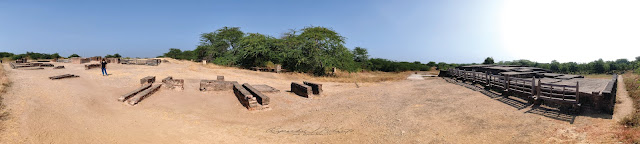
I was out on 550 km drive to Somnath, a long drive after many years. While travelling by SH1 in Gujarat, around 12 noon, I suddenly saw a board indicating Lothal - 4Km, pointing to a narrow road alongside through farm land. I read and went ahead. Had read about Lothal and Dholavira as ancient sites dating back to Harappan times of Indus Valley Civilization. Google map was showing still about 7 hours to destination. Few things were going through my mind. Tough call to invest additional 30-40 minutes. Stopped after about a kilometer of driving, and discussed about it with my travel partner, my wife. Eventually decided that we should see this. Never seen a Harappan site, and in possibility we will not come back to this remote place just to see Lothal. Took a U turn, and hit the narrow single road through farm fields. 

The archaeological site is located a bit inside from the main road. But a a proper road sign to guide visitors was missing. After driving for about 4KM, we found only a Thank You for visit board of Gujarat Tourism. At that point, Goggle was pointing to a near non-existent dirt track covered with kikkar bushes. No one was there to ask for direction. The site has to be there somewhere. As I waited, I saw another guy driving a KA registered car coming back from the opposite direction. He also got confused, and drove ahead only to be reminded by Google to come back. Both of us talked and decided to take the dirt track as Goggle was pointing dots to it. Few meters into the track, we found a sign board indicating Lothal, which is not visible from main road. After about 100 meters of further driving, we actually had reached the place with a board indicating as Lothal. The lone private security guard at gate told us not to get onto the walls or structures. No entry ticket. I found around 4 cars of visitors while I was there. It shows that only a fistful of people visits this place.


There is a roadsign few meters into the dirt track

First thing that stuck me – how come some one (Prof S R Rao) found this site in such a barren and remote area, and excavated it between 1955-62. This Harappan town from Indus Valley Civilisation dated back to 2500-1900 BC. If you read the descriptions at site, the brick structures are actually of that time. Bricks, yes real bricks were used to build this Harappan town. The structures are so well planned and laid out that you will be forced to think if is it really an ancient site. It is an entire small-town setup complete with a water pond. I ended up giving more than planned 40 minutes visiting various parts of the site. The museum is closed permanently. The artefacts from the site are probably too precious to be kept at such a remote place. You can use the toilet there though. I found few more security guard and safai worker there.


It was an overwhelming experience being there. And definitely, one of the most unforgettable chance visits.

Tuesday, December 04, 2018

Capturing the spirit of street-life

Wildlife photography is my preferred genre and will continue to be so in near future. However, like many of my fellow photographers, the visual storytelling side of street photography also has a special appeal to me. This appeal is powerful enough to push me into venturing out 4-5 times during last one year to explore the streets of Delhi, specially the older Delhi. Called the Purani Dilli (Old Delhi), its streets are special. There is a treasure lying to be captured in the busy, over corroded, packed and often dimly lit alleys of Old Delhi. I wish I could go out often.
Staged or As Is:
Street photography is a large term. It actually has many sub-genre. The most common and popular on the social media is the staged street photography. They at time s look awesome. You find the perfect setting, find some actors who will gel with the scene, often pay them in cash or kind, and shoot. You get a near perfect shot for social media. But the form that appeals to me is the shoot as is format. You go out on the street and shoot a scene as it is with real people garnishing it with your creative framing and technical skills, and then present it to your audience with your editing skills. This way you capture moments. While the staged genre will continue to flourish, the moments genre will also hold its special place.

Concept:

It is always good to have a concept in mind to shoot before you step out. If you do not have a concept, then you may find the scene too chaotic. I have seen participants in these walks often trying to shoot what others are shooting. If someone is shooting an old man puffin a bidi, let me shoot that too. And when you see the shots shared later in walk group, you find majority of them crap as they were shoot without any plan or concept. Even if it is not staged, you need a plan and concept to shoot. You will have to find beauty and interest in clutter. You make or create an Image by seeing and capturing differently. Technicalities often takes back seat as you have to shoot fast. Given the general lighting, and your understanding of light and your camera requirement, you set out with a set of basic setting. If a scene appeals to you, aim and shoot framing it the best possible way.
I had tried to create a series of images with a concept of ‘Life In Between’. The images of this series do not require me to connect with the subject. I will come to the topic of connecting to the subject later.

Some bread earned
A Fistful of colours
Pondering
Poles apart....Life of two child

Equipment:

A mirrorless is the best equipment for street photography. This is true for India, at least Old Delhi.
So why a mirrorless for street? I currently own two full frame Canon bodies. For the street outings, I have used the smaller Canon 6D Mark II body with Canon 17-40 F4 lens. Smaller is a relative term. Even the 6D2+17-40 combination looks fairly large as compared to the mirrorless combos. I had found that Canon 6D2 fails you when the light is low and scene has predominantly darker tones. You will come across many such scene once you are inside the labyrinth of narrow alleys of Chandni Chowk like the Kinari Bazar where only natural light you find are wafting through narrow openings. Either you need a F2.8 or better lens and definitely a better body in such places. A cropped body with 18-55 kind of lens is a disaster for those narrow alleys. The other option therefore is the mid-level mirrorless targeted at the prosumer photographers. As they are targeted at prosumer segment, the output is tweaked to be quite good. They boast of an exciting array of lenses. In the last walk, I found that Fuji 18-55 kit lens is a 2.8 at wide angle. This comes a s kit with XT-20 body. The combined size and weight of a cropped body mirrorless is much lesser than my Canon 6D2+17-40. You can easily put them into your bag and carry everywhere. These cameras being small in size, the average people on street will ignore you as a novice, amateur or tourist having fun. The bigger SLR often attracts unwanted attention. These makes you a bigger photographer trying to make money of images of poor people on street.
As I am currently exploring Sony and Fujifilm series for making my next acquisition, I will come back and update this space soon.

Technicalities:

Once out on the street, the technical aspect of camera setting will be least on your mind. Your eyes will be scanning for interesting scene. Rarely you get a second chance. Therefore you have to set your parameters before you start walking. Read the lighting scene and set your Aperture, Shutter Speed and ISO. Reading the available light scene will come from experience. As you will be shooting handheld, you need a minimum shutter speed of 1/60 to get decent frames. Once you have basic settings right, review first couple of shots. Change settings if required. Of course, you will fiddle with settings later as you shoot, but no point changing it after losing a moment. So, get it your initial setting as right as possible. This is true for wildlife also. You need to read the lighting scene and get your first setting as correct as possible.
Ethics:
One important aspect of street photography is to connect with subject. If you are shooting people close up, then you must talk and connect to get the best result. If the subject refuse then simply walk away. But more often than not, the subject is likely to cooperate. Keep in mind that do not try to create a scene of trying to make money of someone’s misery. Sometimes they may ask you for money or help after posing. These are poor people trying to make a living on street. The call is yours. Listen to your conscience. If you ask me, I had done it couple of times by buying a cup of tea or biscuit. I am presenting here few images where we had connected with the subject. Compare these with earlier series of ‘Life In Between’.
When you connect with your subject
Special mentions:
This exploration of city had made me venture out to different old Delhi with various people during last one year. These are Nizamuddin West with Hazrat Nizamuddin dargah and walled city from Turqman Gate to Chawri Bazaar with Asif Khan Dehlvi of Delhi Karavan. These were story telling non-photo walks. As Asif hold the group together with his story telling, I kept exploring with my camera. This continued with exploring the famed Chandni Chowk area from Parantha wali Galli to Dariba Kalan, and Khari Baoli to Sadar Bazar with Sundeep Bali and Fujifilm team. Sundeep is a brand ambassador of Fujifilm who had done a lot of work in old Delhi areas. It was a great experience learning with him.
And finally, this series of images were viewtifully edited on the ViewSonic VP2468 monitor specially designed for photographers.
Note: The author is ColorPro partner for ViewSonic. His and other ColorPro professionals' work can be seen at ColorPro Partners of ViewSonic. The latest series of ViewSonic monitors for Photographers can found at ViewSonic

Saturday, August 18, 2018

Jungfraujoch Switzerland

First video log of Europr trip 2018. Presenting the piciuresque journey to mountain top at Jungfraujoch. A train journey throug snow and tunnel takes you to 11333 feet. The train route itself is an engineering marvel. We experienced snowfall and even blizzard at top.