I do not want to harp upon the natural beauty of Kaziranga. The lush green forest extending more than 425 sq. km is bound to mesmerize you. It has been declared as a World Heritage Site by UNESCO in 1985. It is the homeland of the endangered one horned rhinoceros, and spotting of few of these magnificent beasts roaming in the wilderness is guaranteed in Kaziranga. I have seen a lot of these majestic beasts while travelling through the park since my childhood. The NH-37 from Guwahati to Dibrugarh runs right through the park and more often than not you will see rhinos, elephants and deers while passing through this stretch. The mighty river Brahmaputra flows on the northern boundary of the park thereby providing a very fertile area. The water surge from the river during the rainy season invariably inundates major portion of the park. Few elevated areas have been built close to the highway where animals take shelter during floods from where they cross over to the hills on the other side of the highway. One of my friends, Vaskar Barai had even seen a tiger once during a flood. That was indeed lucky as sighting a tiger in wild is absolutely rare. I have not been that lucky, but once I had almost bumped into a herd of elephants that were crossing the NH while driving from Guwahati to Nazira. Animals crossing the NH are quite common during the rainy season. The road through Kaziranga was a drivers delight and so hardly anyone followed the speed limit set. There always has been causality to animals crossing these corridors. Forest deptt. has now put several speed breakers to tackle this high speed driving through the designated park area.
There are three entry points for going into Kaziranga – Kohora, Bagori and Agratoli each of this being a separate ranges. The most popular range is Kohora followed by Bagori. Like most tourists, I also have been to Kohora only and hence my article is limited to Kohara only. My directions will be from Jorhat side rather than Guwahati side. Kohora is about 22 km from Bokakhat, the nearest town and looks like an ordinary alighting point on the highway. A small no. of shops and a welcome arch ensures that you do not miss it. The road on the left (or right if you are coming from Guwahati) with the big arch leads you to the point where most of the renowned hotels and rest houses are located. Though many new roadside hotels and resorts have come up in the area, this is the best place to stay as the forest office from where you are to obtain passes for entering the park is located here. The hotels here are Banani, Banashree and Aranya. Besides this, there is the Soil Conservation IB where I had stayed. Room rates starts from around 550 onwards. The famous Wild Grass Resort is however about 7 km from here and is located amidst a local village. It is built to give you an ethnic feel. Most foreign tourists stay at the Wild Grass. There is no road sign for Wild Grass and the kachha road that leads to it off the highway is at exactly 5 km from the Kohora point towards Bokakhat. You need to ask someone after traveling for 5 km for the way to Wild Grass. But if you are not a luxury class tourist, then prefer to stay in any of the places I have mentioned above. Their phone nos. are given at the end to confirm availability. Except Hotel Aranya, others accept telephonic bookings. Soon after you arrive rush to the forest office to register your name for elephant safari next morning. Which trip you get to go in depends on your serial no. in their register. The best trip is the second one at 6:30 am and so do not forget to register yourself early. During Mar- April, however the best trip will be the first trip at 5:30 am. If you stay in any far off hotel located along the highway, they may be having some agent to book on your behalf. Get it confirmed beforehand with the hotel. Each trip carries about 50 to 60 tourists depending on the availability of elephants.
I had arrived there around noon and so I had to take the afternoon jeep safari. You can choose to take it in the morning half as well. Afternoon timings are fixed from 3 pm to 5 pm. It was November and so by 5 pm it becomes quite dark in Assam. You have to hire the jeep yourself from market or through the hotel staff. They charge around 650 bucks per trip. Prefer to have a gypsy rather than a jeep as gypsy travels almost noiselessly. Afternoon trip gives you an opportunity to travel alone. If you are traveling in cavalcade, which is normal situation in morning, be sure to be in the front otherwise whirlwind of dust emanating from the kachha track inside the jungle will take some of the fun away. The forest deptt. charges are quite exorbitant. I had compared this with the rates in Periyar NP in Kerala in one of my earlier article. The charge are : Rs.200/- for vehicle entry fee, Rs.60/- per head entry fee, Rs.50/- for still camera, Rs.50/- as guard charges and Rs.500/- if you have a handycam. It is real loot-maar. They will however give you a forest guard who has an old .303 gun to scare animals away, especially elephants, if they attack you.
Day 1: Jeep safariWe entered the jungle through Mihimukh at around 3 pm. It was quite cool in Feb and so animals were around. A kutcha road leads you into the jungle. I am told that this road gets wiped out every year in flood and has to be rebuilt before the park opens. You can easily spot various species of deers and wild boars in swamps alongside the road. The drivers will invariably show you a tree which bears nail marks supposedly of tiger. Soon you will start spotting rhinos and buffalos either grazing or lying lazily in a mud pool. The driver was friendly and we were taken 4/5 km into the jungle to the Diphalu river where we could see some tortoise. They were dangling from trees lying on riverbed. Even the smallest of crackle will scare them to vanish within seconds into water. The air was carrying fragrance of jungle flower. It was a nice feeling to be so deep inside a dense forest. On the way we saw destruction caused by an elephant herd which had crossed that area the day before. If you get an elephant herd on the way, that is the end of safari for you as those beasts will not make for you. The road is very narrow; you cannot turn and run if chased by elephants. On our return, two barking deers, which are rarely seen, slowly walked onto the road hardly 100 meters away from us. They did not hear us coming. That is why I recommended having a gypsy rather than a jeep. Unfortunately my SLR struck in the snap I took with both the deers. However, the second snap with only one of the deers came good. As the sun was setting we were taken to the Diphalu lake for watching the sun set. Few tourist vehicles gathered there for enjoying the sunset. By the time we had returned it was complete dark.
The day was not over yet. At 7 pm the forest office opens for issuing passes for next morning’s elephant safari. You had to be there personally to pay and collect passes. Even if you had registered yourself earlier, if you are not present when your name is called you will miss the chance to choose your trip. Although I had registered at around 3 pm, I got the chance to be in the second trip as many tourists were not present when their names were called. So collect your entry passes before going for dinner. The charges were Rs.120/- per head plus Rs.50/- for still camera.
Day2: Elephant safari
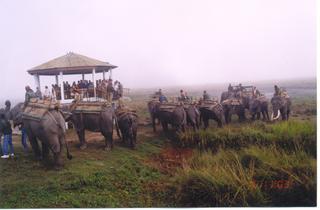
We had to face a cab operator strike and so had to drive down to Mihimukh, the elephant riding point located about 3 km from the highway. We left the vehicle there at the gate and walked down to the tower built for getting onto the elephant. In fact you can easily drive there. The cab operators typically charge Rs.200/- for ferrying you from hotel to Mihimukh and back. The area was still engulfed in thick fog. I felt lucky that I did not have to go in the 5:30 am trip. We waited on the machaan for the elephants to come back from the first trip. It was a wonderful sight to see the cavalcade of majestic animals emerging through the foggy landscape in the distance. There were 17 elephants in the troupe of which 15 are used for ferrying tourists and 2 were under training. Though most of the elephants belongs to the forest deptt., few of them are privately owned. Carrying capacity of each elephant varies depending on its size. We got into a 3 seater pachyderm. Slowly one by one all the elephants vanished into the fog. So did we. The elephants had great difficulty in maneuvering swamps and crossing a small river on the way. I was sitting at the back and felt at times like felling off from the elephant. Soon we were taken to a herd of wild water buffalo which were yet to make its move for the day. After traveling for some time we get to see a rhino. We did not get to see anything else in the one-hour trip. But traveling through the tall elephant grasses, which at times towers above the elephants, in the jungle through the fog was something special. The beauty of the elephant safari is that you can see whatever you get to see from very close. I have read that elephant safari in other national parks is more fun than animal watching. But here you get both the fun and animals. I had really enjoyed the ride. Honestly it was my first elephant ride and I am happy that it was a memorable one for reasons other than that. We came back to Mihimukh in about an hour. Before alighting we ensured to have photograph on the elephant. This was the time my SLR started giving problems. Fortunately our photos on elephant taken by another tourist came good.
That also brings an end to my trip. This is a typical Kaziranga trip we use to enjoy in Assam. If you have planned to spend two days, then you can have the jeep safari at Bagori on the second afternoon. The distance between Kohora and Bagori is about 10 km. It was November when I visited. The park opens for tourists in October and remains open till mid April. But the best time to visit is end March or early April around Bihu (or just before the rain starts). Till about December, your views of the landscape will be blocked by the tall elephant grass jungles that are everywhere. They dries up by January and the forest deptt. set them on fire to clear areas. Once the pre-monsoon rain start setting in, freshly sprouted grass brings out large number of animals into the open and you can enjoy this magnificent view in March - April. However, this window is small as park is closed once the rain gets regular by mid of April. Before ending here are the phone numbers of hotels ----
Hotel Aranya : 03776-262429, Hotel Bonani : 03776-262423,
Soil Conservation IB : 03776-262409
Wild Grass Resort : 03776-262085/262437/ 0361-2546827 (Guwahati office)
For further information, you can try the following link :
Kaziranga National Park


 The flash airfare sale of Feb came as an opportunity
for an unplanned visit my hometown Guwahati after my daughter’s exams are over
in March at unbelievably low fares. Normally I visit my hometown either in May-June or
October when Kaziranga remains closed. Thus I have been missing opportunity to
visit Kaziranga since I got transferred to Delhi. But this visit happening in
March, and also the fact that the park would remain open, I squeezed in a one
day visit to Kaziranga out of a hectic schedule. The 240 km road from Guwahati
to Kaziranga via NH37 is in excellent condition this year as the tar is newly laid.
As we had started early in the morning, it took us 4 hrs to reach our resort at
Bagori. The Nature Hunt Eco Camp, our abode, is a small facility with 3 huts
and 1 dormitory. All huts are made of bamboo and other natural materials to
give you an ethnic feel. The campus had decent green cover and a small captive tea
plantation. The location is about 4km from the Kohora junction on NH37. As I
had a vehicle at my disposal, I did not opt for the lunch (grossly overpriced) at
the resort.
The flash airfare sale of Feb came as an opportunity
for an unplanned visit my hometown Guwahati after my daughter’s exams are over
in March at unbelievably low fares. Normally I visit my hometown either in May-June or
October when Kaziranga remains closed. Thus I have been missing opportunity to
visit Kaziranga since I got transferred to Delhi. But this visit happening in
March, and also the fact that the park would remain open, I squeezed in a one
day visit to Kaziranga out of a hectic schedule. The 240 km road from Guwahati
to Kaziranga via NH37 is in excellent condition this year as the tar is newly laid.
As we had started early in the morning, it took us 4 hrs to reach our resort at
Bagori. The Nature Hunt Eco Camp, our abode, is a small facility with 3 huts
and 1 dormitory. All huts are made of bamboo and other natural materials to
give you an ethnic feel. The campus had decent green cover and a small captive tea
plantation. The location is about 4km from the Kohora junction on NH37. As I
had a vehicle at my disposal, I did not opt for the lunch (grossly overpriced) at
the resort. Rainfall in

