Showing posts with label Jim Corbett. Show all posts

Saturday, March 05, 2016

Sarapduli FRH : A different night out at Corbett

As the sun goes down behind the hills turning the landscape into a canvas of myriad shades of orange, jungle folk leisurely walks back to their cocoons for roosting. And then darkness descends to engulf the forest in a think black blanket, enthusing a new lease of life into the nocturnal fauna. The generally quiet jungle suddenly springs to life with a cacophony of calls and sounds. Predators who rules the night are out on the prowl. Many will not survive the night to see the light of tomorrow. Being out there in the dark is certainly a frightening proposition, but watching this drama unfold from inside an electric fence to fend off the predators is an altogether a different experience. Imagine yourself sitting right in the midst of all these actions, feeling the pulse of the jungle nightlife and soak in the unforgettable experience. Welcome to the Corbett National Park in Uttarakhand, the land of roar and trumpet.

Asitic wild elephants

The evergreen dense forest of Corbett NP with patches of saal trees, grasslands, hills and rivers is the ideal habitat for two of the giants of Indian forests – the Royal Bengal Tiger and the Asiatic Wild Elephants. Corbett is one of those rare places in India that offers feel of real jungle night stay if you can manage to get accommodation in one of its Forest Rest Houses (FRH). These are tourist facilities run by the forest department of Uttaranchal and can be booked online through Corbett’s official site corbettonline.uk.gov.in. Of all the FRHs located across various ranges of the park, the Dhikala FRH is the most sought after, followed by Gairal and Bijrani. All of them are basic facilities, yet any true wild lifer will gleefully trade his luxurious hotel room for a night at these FRH. The Dhikala FRH is the biggest of all the facilities, located 31km inside forest on the bank of Rāmgangā reservoir, has good facilities for food, almost 24 hr electricity and next door access to the famed chaur or grasslands of Corbett. Therefore Dhikala FRH generally stays full with tourists, nature lovers and wildlife photographers. Other rest houses too are alluring, each of them in its unique way. The Gairal FRH and Bijrani FRH too have canteen facilities, but have limited choice of food. They do not have electricity, but are solar powered upto 10pm only. In my last visit this summer, I could not manage booking at either at Dhikala or Gairal. So when I was offered a choice of Sarapduli FRH during my last visit, I thought why not. A different kind of jungle stay was waiting to be experienced.

The Sarapduli FRH is located almost halfway to the Dhikala FRH from the Dhanagiri gate entry point on NH121. Travelling from the Dhanagiri gate, you first reach Sultan FRH. This two room FRH is the only one without any electric fencing and canteen. Hence you need to be super adventurous to plan a night stay here under a small solar lantern in the midst of prime tiger and elephant habitat. Travelling further through large patches of saal forests, after climbing up and down hills, crossing rivulets and, on almost reaching the plains of Dhikala, you reach the Sarapduli FRH. The facility is almost similar to Sultan, but here you have the comfort of an electric fencing.

A tiger in Dhikala zone of Corbett

Entering the Sarapduli FRH campus, we went pass couple of staff quarters lined on both side of the road. At the end of the 200 odd mtr road, which is the other end of the campus, facing a river is the tourist hutment. The building is an old British era heritage. It has two rooms with attached bath. One of the rooms is meant for tourist booking online, and the other for officials or someone who manages booking though connections. As the official room generally remains vacant, you are expected to spend the night alone in that house. The dining hall with a fire place is common to both the rooms. The guest room was smaller as compared to those in Dhikala or Gairal. However the toilet was almost the same size as the room itself. There also is a veranda facing the river, lined with many chairs, in case you find time to relax. You do not get river view though, because of overgrown bushes. About fifty feet away is a 3 bed dormitory in a separate building. Their common toilet is outside, making it scarier.

A modern time extension has been added to the old building, to serve as the kitchen. Cooking gas cylinder is available along with utensils. Charges for using these items are already included in the room rent for the night. Guests are required to carry raw materials for meals. You should be meticulous to carry everything, from salt to sugar to tea to turmeric to spices. You will not get anything there. You may either cook yourselves or else the caretaker will cook. Most guests generally goes out for safari at the crack of dawn, only to return to Sarapduli in the evening. Thus one is likely to have only dinner at Sarapduli. Or a cup of tea in the morning and evening.

Given the surroundings, we were excited at the prospect of spending the night at Sarapduli. It was almost dusk when we hit the campus after safari. Electric fencing were activated soon after we had entered. As we were the only guests for that night, we pulled out chairs in the open while the caretaker served us evening tea. The campus was dimly lit by few solar lights placed along the pathway. As the night fell, the staff quarters, though inside the campus, appeared too far away for comfort. The darkness and silence of the forest was overpowering. It started to engulf all of us, including the driver of my gypsy. He is a local guy, often goes to forest, yet he was scarred to sleep alone in the driver’s room. He cooked up haunting stories. Finally he managed to stay with the caretaker in his quarter. We too had become anxious. Despite being a regular to Corbett, being alone was unique experience.  We had to make a polite query as to how far help is available if we call someone at night. I estimated the caretaker’s room was about 200 feet away. We could see a light in a room about 100 feet away. We were told that a staff sleeps in that room. We were assured somewhat but was not sure how will someone react if we really need help at night.

Discussions on tiger sightings and other incidences accompanied our tea. I always enjoy such discussions with men who spends most of their days and nights in the forest. A storm was building up. Flashes of lightning were illuminating the surroundings occasionally. A cool breeze started blowing bringing in some relief from the heat. As we were enjoying the moments, we felt a sudden commotion along the fence and then a panic call from a scarred Sambhar deer. The source of the call was so close that all of us stood up instinctively. The electric fencing on the side from where the call came is about 100 feet from where we were sitting. Call of Sambher deer is a certainty about presence of a tiger or leopard. It was almost certain that a tiger was walking by the fence, probably to to the adjoining riverbed. We pulled out torches to scan for any sign of animal close to the fence, but without any success. My family made anxious query about safety of the electric fencing. The caretaker did his bit to assure them that bigger animals cannot trespass. There has not been any incident of tiger or leopard straying into the campus. To me a tiger may be too big for the fencing hole, but a leopard can come climbing any of the tree, if it wants to do so.

The mystic Corbett mornings

It was a long day for us and lights were to go off at 10pm. So we went for an early dinner. While waiting for food to be served, my eyes spotted something under a chair in the dining hall. The chair was directly under the only light glowing in the room and hence insects were converging onto it. Smaller insects, that had died, fell to the floor under the chair. Among those dead insects, there was something longer than any insect. So I went to inspect. I got excited to see a small white scorpion about 3 inches long, feasting on the dead insects. What we should have worried is that this scorpion was inside the house, and barely couple of 4-5 feet from the door of the room where we were supposed to spend the night without any electricity. Scary, isn’t it. But this is the thrill of spending a night in a jungle. And where do one get to stay in such a place in these times where humans have not rarely left any space unoccupied. This is Corbett, the real jungle. And this is Sarapduli, providing much better feel of jungle than Dhikala. When I brought it to the notice of the caretaker, he immediately arranged to remove the scorpion. He informed that it is more poisonous than the black scorpion.


The night passed of well. We were provided a small solar lantern for use after lights went off. Though the cacophony of sound had stopped before we went to bed, few Nightjar birds, with its terrible high pitch calls, kept waking us up from time to time. Being peak of summer in May, it was quite hot to spend the night without a fan. We stayed at Sarapduli for one more night. Second night was better with bit of rain and cool breeze. We felt confident to keep the door between bedroom and dining hall open that night. It provided much needed cross ventilation. We slept peacefully that night. Rains kept the nightjars away. I have been to Corbett so many times, generally staying at Dhikala and Gairal. This first time stay at Sarapduli was unique in its own way. We will remember the events of those two nights for a long time. It was a true jungle night stay in all sense. If you are looking for adventure, then you should certainly give it a try. You are sure to be back with treasure trove of memories from these places.

How to reach there:
There are multitudes of options to travel from Delhi to Ramnagar. You can use the Ranikhet Express that leaves every night from Old Delhi. Buses are available from Anand Vihar ISBT. Always travel by Govt Buses in Delhi NCR for safety. We typically hire  a cab which drops us and returns. The cab returns to pick us up on day of retun. By road it is about 240 km and takes 5 hours.

Where to stay:
Forest Rest Houses (FRH) can be booked through forest department's website only, though some agents arranges for your booking for a hefty charge. But no one can arrange a trip for you on short notice. You need to plan in advance. Typically FRH booking use to open 45 days in advance. Rooms are limited and hence gets sold out within minutes of opening. Rules keep chnaging. Pl check the offcial site for recent guideleines at corbettonline.uk.gov.in and select Book Tickets --> Night Stay. There are hundreds of resorts outside the park. You can do day visit Jeep safari only if you stay outside. Even for day safaris, you need to book in adavnce. Else you will end of beeing fleeced by doing safari in buffer zone like Sitabani.


Wednesday, February 10, 2010

Corbett : a second time

Getting geared up for my second trip to Corbett next weekend. My first trip was in 2008 when I had availed a KMVN package from Delhi. This time it will be a drive in trip. Last time we had stayed at the Dhikala FRH complex. This time we be staying at the Gairal Forest Rest House.  Gairal FRH is also supposed to be a self sufficient complex. On my return, my blog will have review of both Dhikala and Gairal complexs.

Wiser from the experiences of last visit, we knew that our second visit will be a drive in one. A drive in trip requires acomodation in any of the FRH which has to be booked directly with Corbett authorities. The net result is that we will be getting full 2 days inside the park and no missing safari trip because of shortages of safari vehicle. You can actually drive around in the park if you have your own vehicle. Of course you have to be familiar with the park. The entry permits are issued for 2 nights which means you have to report back on 3rd day. When we took the KMVN package, we effectively got only 1 full day inside the park as travelling by road from Delhi we could arrive at Ramnagar only by noon and Dhikala by afternoon. Thus day 1 was wasted in reaching Dhikala, day 2 was spent inside and day 3 we had to leave by 10 am. This time we will be leaving Delhi a day prior to our reservation date. After collecting the gate passes for next day, we plan to retire in a private resort that dots the highway from Ramnagar to Dhanagiri gate. As there are 77 resorts in the area and we are a group of 4 families, we can expect a good bargain for a night stay. We can enter the park early next morning. By driving own cars we will not be wasting time in hiring a jeep.

Booking accommodation directly is a painful and laborious process, but worth it. However, if you want to experience the real Corbett, then you have to manage your stay in one of the FRHs deep inside forest. Dhikala is 31 KM and Gairal 18 KM inside from the Dhanagiri gate. These are solar powered complexes with electric fencing for your protection. All packages offered by private tour operators are for resorts outside the park. You are allowed to enter the core zone through the Dhanagiri gate only if have confirmed accommodation in a FRH. If you stay in private resort then your chances of visiting this core zone is almost nil and have to satisfy yourself by visiting smaller tourism zones like Birjani and Zirna. We faxed our accommodation request for Feb 2010 in the last week of December 2009. You need to plan at least a month ahead, better if you can send the request 2 months ahead. We had given many dates like all combination of Fri + Sat, Sat + Sun and Sun + Mon to ensure that we can use the weekend and manage the 4 day trip with 2 days leave. This followed several phone calls to ascertain that the fax has been received. We were informed that the our request no was 120 in queue for February. The accommodation was confirmed in the last week January. On confirmation we had to make a DD in SBI (only bank they accept) for payment which was Rs.1250/- per room per night and then send the DD by Speed Post. We followed up to ascertain that DD has been received which confirms the booking. Room rates have gone up considerably. The rates given in their website are quite outdated. It probably has been revised twice. I will be able to put up complete information on return. But as of now, tentative room rent is Rs.1250 + Rs.250 (Housekeeping charges) = Rs.1500/= per night. Even then it is cheaper than private run packages which quotes a per person rate of about 3000.

If you want to book FRH accommodation, then send a fax addressed to the Director, Corbett Tiger Reserve, Ramnagar – 244715. Fax no. is 05947 – 251012. Booking office telefax is 05947 – 251376 for following up activities. The fax should have your address, contact no and tentative dates. It has to be a range of dates rather than being just two dates.

Monday, April 07, 2008

Jim Corbett : From a hunter to a legend

Ramnagar, a small town in Uttaranchal, is infatuated with the words Jim and Corbett. Everything from dhaba, to tailor shop, to saloons to costly resorts has to have one of these two words in their name. The town has probably nothing to do with Lord Ram, but with Jim Corbett. It owes its fame to the Corbett National Park which provide livelihood for a sizeable population of the area. Such is the importance of these names that the town should have been named Jimnagar, Jimpur or Corbett nagar.

Anyway, my renewed interest in Jim Corbett after my recent visit to the first national park of India, now named after the famous British hunter turned conservationist, had made me acquire a compilation of his famous books. His hunting stories have been translated into almost all languages in India. I had read few of his stories translated into Assamese as part of our curriculum, probably in class VI or VII, i.e. some 25 years back. Such powerful and engrossing were the stories in that book called Araonyar Moh (Lure of the Jungle) that they are still vivid in my mind, specially the one about the Man Eating Leopard of Rudraprayag, the Man Eater of Mohan and the Prince of Powalgarh. Corbett’s translated stories had left indelible mark in our young minds. 25 years hence, I saw the original books written by the man Corbett himself in the souvenir shops around the park. These books are published by Oxford University Press, India. I wanted to get the one named ‘The Jim Corbett Omnibus Vol-I’ which is a compilation of his 3 famous books viz. Man eaters of Kumaon, Temple Tiger and More Man Eaters of Kumaon, and the Man Eating Leopard of Rudraprayag. However none of the shop were willing to give any discount on the MRP of 555.

On my return to Delhi, I had procured the book through the newly launched site A1Books India. I got the book for Rs.475 (against MRP of 555) with free delivery and delivered in 2 days of placing the order. It was quick service, may be because the vendor was from Darya Ganj, some 10 km from my address. But I was happy with the service. The reading started the night of the books’s arrival.

I was a voracious reader many years back. I was one of those kind who would finish a novel in one go. But that habit had died over the years. More so after getting married and having a kid. Every time I tried to pick up a book, the intervention in the form of my dear wife or kid would nip it in the bud. I had been trying to read Khuswant Singh's Delhi for more than a month without any success. This time I specially told them not to disturb me. My kid was happy to listen the hunting stories at bed time. Despite the occasional protest from my wife, I had finished the book containing 600 pages in about a month’s time. That is a big achievement.

After reading the book few things had dawned on me. The translated version was much easier to comprehend, specially the portions where Corbett tried to give vivid description of a location. It is difficult to conjure an image of the location from the descriptions. I had tried making a sketch on paper on few occasions to have a better understanding. The translator had probably left out those portions for better understanding of the readers.

The second thing that had dawned on me is that despite becoming a conservationist in his later life and calling the tiger a ‘Big Hearted Gentleman’, Corbett had killed many leopards and also the occasional tiger for hunting pleasure. He killed the tiger referred to as the Prince of Powalgarh apparently for no reason. It was not man eater. He had referred to hunting as sports and fellow hunters as sportsman. The skins are called as trophies. It appeared that that the tendency to kill a tiger or snake on sight is inborn in human. This human tendency has led these majestic animals to near extinction. Corbett was also no exception. However, he realised his mistakes and traded the gun for a camera. This change in Corbett was responsible for the efforts towards tiger conservation in India.

The third realisation was that Corbett was an exceptionally brave man. In simple words he was different from others. Man eater hunting on foot was thought to be suicidal. He would go into the jungle in search of a man eater and would come out after a couple of days. When night falls, he would climb a tree and sleep. He often stayed alone at deserted dak bungalows in remote hilly areas and go in search of a man eater alone. But even a brave man like Corbett, who had spent night after night in tree tops in jungle infested all kind of wild animals or sitting in dark with a partly eaten human body, had mentioned about few incidences which to him was not natural. He told that he had no explanations for these supernatural occurrences. Reporting of these incidences was from a man as courageous as Corbett makes one really ponder about supernatural occurrences.

Finally, I was almost in tears reading the story of a young Garhwali soldier who lost his legs in the World War-II in the last chapter of Man Eating Leopard of Rudraprayag. The young man, who could not see the Saheb that killed the infamous leopard because his father could not carry him the long distance from his village to Rudraprayag, was so happy that he could see and speak to that saheb after 18 years. He was happy because he can go back to his village and can tell his father and folks proudly that he had met and speak to that Saheb. Just meeting Corbett had made him forget his misery of losing his legs at war at such a young age. This respect from Indians, specially from the peoples of Kumaon and Garhwal to whom he was a saviour and who believed that he was bestowed with some supernatural power that had enabled him to kill so many notorious man eaters, had made Corbett love this country. This respect had also made him a legend for the people of the hills.

Friday, October 21, 2005

Jim Corbett: the legend

Jim Corbett is a legend in Kumaon. He had left his footprint all across Kumaon saving lesser mortals from the jaws of man-eater tigers. Come to Ramnagar and you will feel the legend. The word Corbett had to be there somewhere in the names of any hotel, resorts or restaurants. Affectionately called the Carpet Sahib by local villagers, he seemed to be equally popular or may be better known than the father of the nation in this area. We had read about him in school, probably in class VII. It felt great to be at Arundel, his house at Kaladhungi which is now a museum run by the Corbett National Park. On our way back, we got the opportunity to travel by NH121 that runs right through the national park.
The Corbett Museum, Kaladhungi :
This is Arundel, the winter home of the Corbetts located at Kaladhungi. It is on the Kashipur -Bazpur - Haldwani road. Corbetts used to live in Nainital during summer and came down to kaladhungi during winters. A shortcut to Nainital starts right infront of the house. Nainital is just 32 km from this point and we travelled by this road to Nainital.
The house is located on a spreawling 10 acre complex. There are two seperate houses located close by. Few of Corbett's belongings are on display. In one section, there are some paintings depicting his life. The museum remains open upto 5 pm in summer. The gate fees charged is 5 rupees for adult and 1 rupees for child. It is managed by the forest deptt.
If you are a Corbett fan, you should not miss this. There is a luxury resort named Corbett Camp Jungle Lore very close this museum. But honestly speaking, this place is very far away from the actual Corbett National Park, around 30 km. The visit had renewed my interest in Jim Corbett. I came across many stratling facts whcih were not available in our school book. I had compiled a brief on the life of Jim Corbett which I share with you. If you are planning a visit to the park, you should know about this great gentleman.

The life of Jim Corbett (1875 - 1955) :
He was born as Edward James Corbett on 25 July, 1875 at Nainital. His father Christopher William Corbett had left military service and moved to Mussorie in 1858 where he got the job of postmaster in Mussorie. There he met Mary Jane who also had moved to Mussorie after lsoing her husband in the sepoy mutiny of 1857. They got married on Oct 13, 1859. Therafter he was transferred to Nainital in 1862 (and it took almost a month for the family to relocate). Jim lost his father when he was just 6. He wrote about how his mother Mary Jane had to struggle to bring the children up. They in fact had very large family. Jim’s parents had a total of 14 child of which 8 were from their wedlock and 6 (3 each) from there first marriages.

His brother Tom used to take young Jim into jungle for hunting for food. It is Tom from whom he leaned the first lesson in hunting. Growing up with the jungles made him a master of the jungles. Corbett started with a catapult to shoot down birds. He got his first gun, a double barreled muzzle loader, from his cousin Stephen Dease as a gift. Stephen wrote a book on birds of Kumaon and Jim collected more than 100 specimens for him with his catapult. He shot his first leopard when he was just eight. His reputation grew fast in Kumaon and received his first request to track a man-eater in 1906. The first man eater he killed was the Champawat Tiger in 1907. Between 1906 and 1941, he had slayed ten man-eaters in different parts of the Kumaon region of Uttaranchal.

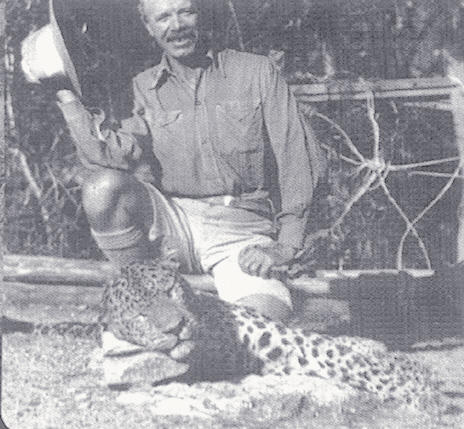
Corbett was not just a hunter. He was a naturalist. He loved the wild and respected the big cat. He never killed a tiger for money or fun. He killed only the man-eaters to save lives. He was affectionately referred to by the locals as Carpet Sahib who would search jungles with inhospitable terrains for days in the trail of that eluding man-eater tiger. The combined total number of people killed by the man-eaters Corbett hunted exceeded 1500. The Champawat tiger itself had killed 436 documented victims. Similarly, the man eating leopard of Rudraprayag (see the photograph), killed in 1925, had 114 victims to its name. Deeply pained at the growing number of hunters and destruction to wildlife, he campaigned for the need to preserve the wildlife and devoted his later part of life for this purpose. He helped create the Association for the Preservation of Game in the United Provinces, and the All-India Conference for the Preservation of Wild Life, and he established India's first national park, inaugurated in 1934 in the Kumaon Hills as the Hailey National Park. This has been renamed in his honour as the Corbett National Park. In later part of his life he also took to wildlife photography.

Corbett was also a keen entrepreneur. After schooling, he joined the services of Bengal and North Western Railway at the age of 17. After few years he left service and started his own business. He had acquired a company called FEG Mathews & Co. for carrying out his business. He also started a large farm in a village near Kaladhungi. The farm is located in a village called ‘Chotha Haldwani’ is now a tourist spot. He owned many houses in Nainital where the Corbett household were settled. Corbett family had an established real estate business in Nainital which Jim carried forward. In fact his mother was said to be the first real estate agent of Nainital. Corbetts had a house in Kaladhungi where they lived during winters. It was built by his father.
Jim Corbett had also served in the army and took part in 4 wars. He had raised a battalion of Kumaoni locals and took few of them to fight in France in 1917. In 1939 Corbett volunteered to take part in the WW-II and trained allied soldiers in jungles survival in Burma. But the stress took a heavy toll of ageing Corbett. He had infected both Typhoid and Malaria during this period. After recuperating, he started penning his hunting stories. His first book, The Man-Eaters of Kumaon (1946), turned out to be best seller and has been translated into more than 30 languages., The Man-Eating Leopard of Rudraprayag (1948), and the Temple Tiger and More Man-Eaters of Kumaon (1954). He finally retired to Kenya with his sister Maggie (Margaret Winifred) in 1947. He had a special bond with Maggie among all his siblings right from his childhood. There he took up farming and continued to write. He died there of heart attack in 1955.

Want to know more. This site on Jim Corbett put up by Corbett Study Group had a very detailed description of Corbett’s life.